On this page
- Too much detergent leaves a film; too little leaves food. 4
- Rinse-aid too low leaves white stains, too high leaves light blue stains. 2
- Tablets belong in long programs; use powder in short ones. 45
- Do not overload racks, and check the spray arm can turn freely. 3
- Rust stains have causes in the dishes, the salt cap or poor grounding. 1
Why are my dishes cloudy or spotted after a Bertazzoni wash?#
Usually because of the detergent amount, the rinse-aid level or the water. The manual lists these causes for whitish stains: not enough detergent, rinse-aid or softener set too low, hard water, and a salt compartment cap that is not closed properly. 13
Each cause has its own fix, and the manual gives it next to the symptom.
| What you see | Cause in the manual | What to do |
|---|---|---|
| Whitish stains on dishes | Not enough detergent | Use the amount in the program table 3 |
| Whitish stains | Rinse-aid or water softener setting too low | Raise the rinse-aid and/or softener level 3 |
| Whitish stains | High water hardness | Raise the softener level and add salt 3 |
| Whitish stains | Salt cap not closed properly | Check that the cap is closed 3 |
| Light blue stains | Rinse-aid dose too high | Lower the level 2 |
| Rust stains | Dishes not dishwasher-proof, salt cap open, spilled salt or poor grounding | See the table below 1 |
| Detergent left in the compartment | Compartment was wet when filled | Dry it before use 1 |
The settings that change the rinse-aid and the water hardness sit in the menu on the control panel. You reach it by holding the Extra Dry button for 3 seconds. 2 Our guide on dishwasher codes and the salt and rinse-aid lights covers the lights; this guide stays with the dishes.
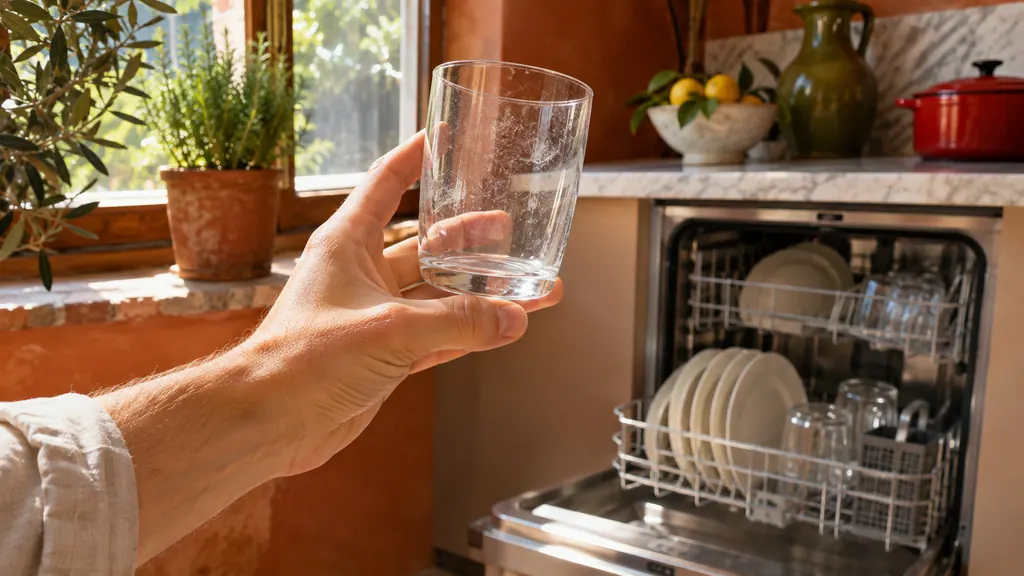
What if the glasses look etched instead of spotted?#
Soft water plus too much detergent is the risk. The manual says too much detergent in soft water may cause glass corrosion, and it repeats the warning: do not use too much detergent if your water supply is soft. 4 Etching cannot be wiped off, so correct the dose before the glasses are damaged.
The opposite problem, white watermarks on glassware, is the signal to add detergent when you use the 15 ml starting amount. 4 Change one setting at a time and run a couple of loads before you judge the result, so you know which change made the difference.
How much detergent should I use?#
Use the amount the program table gives for the cycle, and less if the dishes are only lightly soiled. The manual warns that excess detergent can leave a film on dishes and inside the dishwasher and make washing worse. 4
The program table lists 1 3/4 tbsp (25 ml) of powder for most cycles and 1 tbsp (15 ml) for Crystal & China. 4 The detergent dispenser takes at most 2 3/4 tbsp (40 ml). More may be needed depending on soil and water hardness. 4
A few more points from the manual are worth repeating. 4
- Use only detergents made for household dishwashers: powder, gel or tablets.
- The amount needed depends on the cycle, the load and the soil level.
- Too much detergent in soft water can corrode glassware and does not dissolve.
- If you do not know your water hardness, use 15 ml (3 tsp), and increase it if you see white watermarks on glassware.
- Keep detergent cool and dry, out of children's reach.
Check after each program that the detergent dispenser is empty. 4 Fill it just before the start of each program, and put in more detergent when dishes are heavily soiled. 5
Do tablets and combined detergents change anything?#
Yes. Tablets belong in the dispenser, never in the tub or the cutlery basket. They may not dissolve fully in short programs, so the manual recommends tablets with long programs and powder in short ones. 45
Combined detergents hold detergent plus rinse-aid, salt replacement and other parts. 5 Two consequences follow.
If you stop using combined detergents, make sure the water hardness and rinse-aid settings are back at the right level. 5 And if you want better results with combined detergents, the manual suggests adding salt and rinse-aid and setting the hardness and rinse-aid settings to the lowest position. 5 The rinse-aid page adds that rinse-aid is not needed with Tab detergents. 2
Two sources in the same manual speak slightly differently about rinse-aid with tablets: one says rinse-aid is not needed, the other says better results come from adding it. If your glasses come out cloudy with tablets, the second approach is the one to try. 25
Why are there blue or white marks, and how do I set the rinse-aid?#
Rinse-aid helps dishes dry without streaks. Too low a dose leaves white stains on glasses and dishes, and too high a dose leaves light blue stains. The factory setting is level 4 on a scale of 1 to 5. 26
- 1
- 2
- 3
- 4
- 5
To fill the compartment, open its cap, fill to the MAX level, then close the cap until it clicks. Do not overfill and wipe any spill. Only rinse-aid made for residential dishwashers goes in; detergent in the rinse-aid dispenser will damage it. 2
Why is food still stuck on the dishes?#
The manual's causes: dishes placed so that water cannot reach them, dishes leaning on each other, too little detergent, a program that does not suit the load, spray arms clogged with food, and clogged filters or a misplaced filter. 3
Its answers are practical. Do not overload the baskets. Place the dishes as instructed in the loading section. Pick the program from the program table that fits the soil. Clean the holes in the spray arms with a thin object. Check that the drain hose and filters are fitted correctly. 3
A spray arm that hits dishes in the lower basket also makes shaking and bumping noises, and the fix is to move or remove the items that block it. 3 For the cleaning itself, our guide on monthly dishwasher cleaning shows how to take out the filters and arms. The dishwasher filters entry describes the parts.
What causes rust stains?#
Four causes are given: poor stainless steel quality in the dishes themselves, a high level of salt in the wash water, a salt compartment cap that is not closed properly, and too much salt spilled while filling. A fifth, poor mains grounding, calls for an electrician right away. 1
The first four have simple answers. Use only dishwasher-proof sets. Adjust the water hardness level using the hardness table. Close the cap properly. Use the funnel when filling with salt to avoid spills. 1 The poor-grounding cause is different: the manual says to consult a qualified electrician immediately. 1
If the salt overflowed and you do not start the machine at once, run a short wash program to protect the machine from corrosion. 6
When should I book a technician?#
Book a visit if clean filters, clear spray arms, the right dose and a correct load do not improve the result, if an error code shows on the panel, or if the machine stops during a program for reasons the checks do not explain. 3
We are an independent repair company, not part of Bertazzoni. A dishwasher under the manufacturer's own warranty is repaired through the manufacturer. For other units, book a visit; the technician agrees the price with you before any work starts, and the exact cost is confirmed after the on-site diagnostic. See our dishwasher repair page and the page on dishes that stay dirty.
Sources#
- INSTALLATION MANUAL / USER AND MAINTENANCE MANUAL DW24T3IXT/26 - DW24T3IPT/26Bertazzoni S.p.A. (official manual PDF, us.bertazzoni.com Specifications Library) · PDF created 13.11.2025 (no printed edition) · PDF p54: troubleshooting, rust stains and detergent remains
- INSTALLATION MANUAL / USER AND MAINTENANCE MANUAL DW24T3IXT/26 - DW24T3IPT/26Bertazzoni S.p.A. (official manual PDF, us.bertazzoni.com Specifications Library) · PDF created 13.11.2025 (no printed edition) · PDF p47: rinse-aid usage
- INSTALLATION MANUAL / USER AND MAINTENANCE MANUAL DW24T3IXT/26 - DW24T3IPT/26Bertazzoni S.p.A. (official manual PDF, us.bertazzoni.com Specifications Library) · PDF created 13.11.2025 (no printed edition) · PDF p53: troubleshooting, food waste and whitish stains
- INSTALLATION MANUAL / USER AND MAINTENANCE MANUAL DW24T3IXT/26 - DW24T3IPT/26Bertazzoni S.p.A. (official manual PDF, us.bertazzoni.com Specifications Library) · PDF created 13.11.2025 (no printed edition) · PDF p45: detergent and rinse-aid dispenser
- INSTALLATION MANUAL / USER AND MAINTENANCE MANUAL DW24T3IXT/26 - DW24T3IPT/26Bertazzoni S.p.A. (official manual PDF, us.bertazzoni.com Specifications Library) · PDF created 13.11.2025 (no printed edition) · PDF p46: filling the detergent, combined detergents
- INSTALLATION MANUAL / USER AND MAINTENANCE MANUAL DW24T3IXT/26 - DW24T3IPT/26Bertazzoni S.p.A. (official manual PDF, us.bertazzoni.com Specifications Library) · PDF created 13.11.2025 (no printed edition) · PDF p48: rinse-aid levels and the salt dispenser